
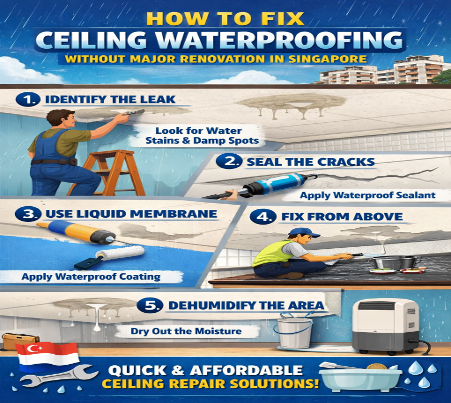
Ceiling leaks are one of those problems that most property owners in Singapore will face sooner or later, especially in older HDB flats, condos, or landed homes with ageing waterproofing systems. You might notice water stains, peeling paint, or even dripping during heavy rain or when your upstairs neighbour uses the bathroom. The immediate reaction is often panic, followed by the assumption that a full-scale hacking and renovation job is needed. But the reality is that not every ceiling leak requires major renovation.
In many cases, you can fix ceiling waterproofing issues effectively using targeted, non-invasive methods, saving both time and cost. This article breaks down how this works, and what practical solutions are commonly used in Singapore.
Understanding the Root Cause First
Before jumping into any repair method, it’s important to understand that ceiling leaks are usually a symptom, not the actual problem. In Singapore homes, most ceiling leaks originate from:
- Bathroom waterproofing failure from the unit above
- Cracks in reinforced concrete slabs
- Pipe leakages (especially concealed pipes)
- Poor sealing at floor traps or sanitary fittings
Because water travels, the leak point you see on your ceiling is often not directly below the source. That’s why proper diagnosis is critical before jumping into any major remedy works that involves unnecessary costly hacking which many homeowners dread.
Option 1: PU Injection Grouting (Most Common Solution)
If your issue involves cracks in the concrete slab or water seepage through structural joints, Polyurethane (PU) injection grouting is often the go-to method in Singapore. Small injection points (packers) are drilled into the ceiling slab, where PU resin is injected under pressure, expanding upon contact with water to seal internal voids and cracks.
It’s effective because it requires no hacking, targets the exact leakage path internally, and can be applied quickly, often completed within a day if the leak is not too severe. This method is widely used in condos, HDB flats, and even commercial buildings because it minimizes disruption, especially important if access to the upstairs unit is difficult.
Option 2: Crack Sealing with Waterproof Sealants
For minor leaks caused by hairline cracks or surface defects, sealing may be sufficient. Contractors typically open up visible cracks slightly, apply waterproof sealant or epoxy, and reinforce with bonding agents, making this method more suitable when leakage is minimal, there is no active water pressure behind the slab, and the issue is localized. It’s a cost-effective solution, but not ideal for major or recurring leaks.
Option 3: Ceiling-Level Waterproof Coating (Temporary Control)
Yes, you can waterproof from below, but with limitations. Applying a liquid membrane on the ceiling can reduce dampness, prevent staining, and improve appearance, though it doesn’t stop the root cause if water is still entering from above; think of it as a control measure rather than a permanent fix, and it works best when combined with PU injection and crack sealing.
Option 4: Fixing from the Source (Without Full Renovation)
If access to the upstairs unit is possible, full hacking isn’t always necessary, as targeted repairs like resealing floor traps, replacing silicone joints around shower areas, and applying nano-waterproofing over existing tiles can be carried out. Nano-waterproofing is a modern method commonly used in Singapore that avoid tile hacking, are faster to apply, and still provide decent protection, making them especially suitable for tenanted units or when the upstairs owner is cooperative but unwilling to undergo major renovation.
Option 5: Pipe Leak Rectification
Sometimes the issue isn’t with waterproofing but plumbing such as concealed pipe leaks within the slab, loose joints, or aging systems, in which case pressure testing is conducted and pipes are repaired or rerouted with minimal hacking only where necessary. Misdiagnosing a pipe leak as a waterproofing issue can lead to repeated failures and should not be overlooked.
Why This Happens So Often in Singapore
Singapore’s climate characterised by high humidity, frequent rainfall, and daily water usage in bathrooms places constant stress on waterproofing systems, and with many HDB flats now over 20–30 years old where original membranes have degraded, ceiling leaks are not uncommon, especially in older estates.
One of the biggest concerns homeowners have is cost, and based on typical market practice in Singapore, PU injection is a moderately priced yet highly effective solution, crack sealing is lower cost but limited in scope, waterproof coating is more affordable but temporary, source repair without hacking falls in the moderate range depending on access, while full hacking and re-waterproofing is the most expensive overall.Non-hacking solutions can cost significantly less than full renovation, often by about 40–70%.
When You Actually Need Major Renovation
However, some situations still do require hacking like when the waterproofing membrane has completely failed, tiles are debonded or hollow, or leakage is widespread across the entire bathroom, in which case surface-level solutions won’t last. But in cases of homeowners dealing with isolated leaks, non-invasive methods are often more than sufficient.
If you’re dealing with a ceiling leak, don’t rush into hacking works. Start with a proper inspection to determine whether the issue is waterproofing or plumbing, consider non-invasive solutions first, and ensure a warranty is provided for the repair; also, communication with your upstairs neighbour is key, as in Singapore resolving ceiling leaks often requires cooperation between units.
Fix Ceiling Waterproofing Without Waterproofing
Ceiling waterproofing issues can feel overwhelming, but they don’t always mean tearing apart your home. With modern repair methods like PU injection and targeted sealing, many problems can be resolved efficiently without major renovation. The key lies in proper diagnosis and choosing the right method for the specific issue.
If handled correctly, you can stop the leak, protect your property, and avoid unnecessary costs, all without the mess of hacking.